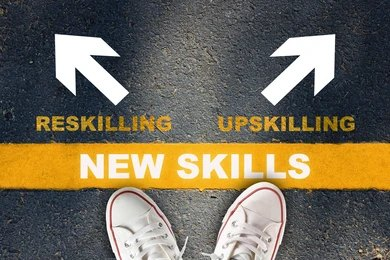
Rapid automation and shifting industry demands threaten career stability. Navigating modern job markets requires clear direction: audit your skill gaps, evaluate industry demand, and choose structured, credential-backed upskilling or reskilling paths to ensure long-term relevance and professional growth.
Key Takeaways
Career paths rarely move in a linear pattern anymore. Automation, AI adoption, and shifting industry demand mean most professionals will need new capabilities within a few years, not a few decades.
Two strategies dominate that conversation: deepening knowledge in what you already do, and pivoting into something new. Knowing which one fits your situation, and when, can be the difference between staying relevant and starting over.
This blog will explain both strategies, when each applies, and how to build a credential-backed plan around your next career move.
Understanding what is upskilling and reskilling starts with intent. Upskilling means building on the skills you already have to grow within your current role, function, or industry. For example, a project manager learning advanced risk frameworks.
Reskilling means acquiring an entirely different skill set to move into a new role, function, or industry altogether. Such as, a customer-support agent training to become a data analyst.
Both responses share a root cause: the World Economic Forum estimates that global trends in technology, economy, demographics, and the green transition are projected to generate 170 million new jobs by 2030. All while displacing 92 million others that will also reshape workplace requirements.
Neither strategy between upskilling and reskilling is inherently better; the right choice depends on whether your current career lane still has room to grow, or whether the ground beneath it is shifting entirely.
So what is the difference between upskilling and reskilling in practice?
Both have the same goal: to help you advance in your career and improve in your job roles while keeping up with industry trends. But there are distinctions. The table below breaks down how the two compare across the factors that matter most when planning a career move.
| Factor | Upskilling | Reskilling |
| Goal | Deepen expertise in your current role or field | Transition into a new role or field |
| Skill overlap | High; builds on your existing base | Low; largely new competencies |
| Typical trigger | Promotion, tech shift within your role | Job displacement, industry decline, career pivot |
| Time investment | Shorter; targeted courses or certifications | Longer; foundational plus applied learning |
| Risk profile | Lower; extends a proven career lane | Higher; unproven territory, higher payoff potential |
| Example | Marketer learning AI-driven analytics tools | Marketer transitioning into a data science role |
Table 1: Difference Between Upskilling & Reskilling
The reason why upskilling and reskilling are important comes down to market velocity. Global surveys consistently show that a majority of employers expect skill requirements to shift meaningfully within the next few years, driven by AI adoption, automation, and changing consumer demand.
Professionals who wait for disruption to force a decision typically have fewer options and less negotiating power than those who plan well in advance. Employers, in turn, increasingly favor candidates who can demonstrate validated, credentialed skills over unverified claims on a resume.
This makes structured learning paths and recognized certifications a practical signal of readiness, not just a personal development exercise.
|
TIP: Before committing to a learning path, audit three months of job postings in your target role. Heavy overlap with your current skills signals upskilling; gaps in core requirements signal reskilling is the better fit. |
While there is no hard and fast rule, your choice is largely dependent on what your goal is. Deciding upskill vs reskill starts with an honest look at three questions:
Based on the answers and the self-assessment below, you can properly map them to a direction.
| Signal | Points to Upskilling | Points to Reskilling |
| Industry outlook | Growing or stable demand | Declining or automating roles |
| Skill relevance | Core skills still valued | Core skills increasingly obsolete |
| Motivation | Want to go deeper, lead, or specialize | Want a different field or function entirely |
| Timeline | Need results within months | Can invest in a longer transition |
| Risk tolerance | Prefer a lower-risk, proven path | Comfortable with a higher-risk, higher-reward pivot |
Table 2: Which One Should You Go For?
|
USE CASE: A mid-career software tester who deepens automation and performance-testing skills to move into a senior QA lead role is upskilling, expanding expertise inside the same career lane rather than changing it entirely. |
Once you understand the difference between reskilling and upskilling as it applies to your situation, the next step is building a plan rather than picking a single course. Start by auditing your current skills against job postings for both your existing role and any role you're considering.
Identify the two or three highest-leverage gaps, and prioritize credentials that are recognized by employers in that field rather than the most popular option. A focused plan built around one or two validated certifications typically outperforms a scattered mix of unrelated courses.
|
CAUTION: Reskilling into a saturated new field without validating demand can stall a career instead of advancing it. Check job-market growth and employer-recognized credentials before switching direction; not after you've already enrolled. |
Since both strategies work best when backed by recognized credentials, it helps to see how they map onto real certification tracks. Our certification programs span project leadership, AI, Lean process improvement, cybersecurity, and healthcare quality. This makes the certifications able to support both upskilling and reskilling journeys depending on where you're starting from.
| Career Move | Path Type | Relevant GIPMC Track |
| Deepen project leadership skills | Upskilling | Project Management Certification (PMC) |
| Expand into process improvement/efficiency | Upskilling | Lean Green Credential (LGC) Lean Black Practitioner (LBP) |
| Pivot from IT support into cybersecurity | Reskilling | Cybersecurity & Information Protection track (e.g., CSP-G, CPTP) |
| Pivot from a non-technical role into AI | Reskilling | Artificial Intelligence Practitioner (AIP) Certified AI Strategy Leader (CAISL) |
| Pivot into healthcare quality/compliance | Reskilling | Healthcare Quality Management Professional (HQMP) |
Table 3: Suggested Certification Path
Whether it is about upskilling or reskilling, which skills should you go for? Soft skills and hard skills complement each other, but sometimes you might only need one. Read our other blog on “Hard Skills vs. Soft Skills: Which Should You Prioritize in 2026?” to understand better.
|
USE CASE: An operations coordinator with no security background who earns a foundational cybersecurity credential and later a penetration-testing certification is reskilling, building an entirely new specialization to enter a different profession. |
Upskilling and reskilling aren't competing strategies; they're two tools for the same goal, which is staying valuable in a market that keeps changing. The right choice depends on where your industry is headed, how much of your current skill set still applies, and how much time you have to invest.
Whichever path fits, pairing it with a globally recognized, structured certification turns learning into a credential employers can verify your skills and the career that you are aiming at. It also turns a reactive career move into a deliberate one.
Explore our range of certifications today and choose the one that fits your career and job role. Register now or contact us to consult about certifications.
Employers often provide tuition reimbursement, dedicated learning stipends, internal mentorship programs, and access to credentialing platforms to support employee development.
Yes, adaptability, leadership, and emotional intelligence are critical across both paths, ensuring technical expertise translates into effective performance.
Highlight completed certifications, hands-on projects, and transferable skills prominently near the top of your resume to demonstrate practical capability.
Micro-credentials offer targeted, cost-effective skill acquisition, helping professionals rapidly prove mastery in specific tools before pursuing full certifications.
Freelancers can audit market demand to expand existing service offerings through upskilling or transition into high-paying niches via reskilling.