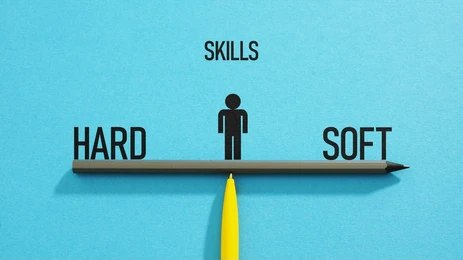
You need to know the answers to “what are hard skills” and “what are soft skills”, the differences between them, how they work together, and which capabilities employers increasingly value. This will help you make smarter career decisions in 2026 and enhance your chances of recruitment to top-tier leadership positions.
Modern workplaces are changing very rapidly, with AI, automation, digital tools, and evolving business models redefining employer expectations from professionals. That makes one question especially important: should you invest more time in technical expertise or people-focused capabilities? Understanding hard skills vs soft skills differences can give you a practical way to answer that question.
Before you decide what skills to prioritize, you need to understand the difference between hard and soft skills. Hard skills are measurable capabilities that you can learn and develop with educational courses, or by taking technical training and certification programs, or even with hands-on experience. Your capabilities to perform technical tasks such as data analysis, project management, accounting, programming, cybersecurity, and financial modeling can be considered examples of hard skills.
So, what are hard skills in practical terms? They are capabilities that allow you to perform specific tasks or responsibilities. A project manager, for example, may need to master scheduling, budgeting, risk analysis, and project planning skills.
Soft skills are different. They influence how you interact with people, communicate ideas, solve problems, manage pressure, and lead teams. Common examples include communication, adaptability, emotional intelligence, collaboration, negotiation, and decision-making.
So, what are soft skills? Well, they are transferable interpersonal and behavioral capabilities that will shape how effectively you can use your knowledge and interact with colleagues, clients, managers, and stakeholders.
| Factor | Hard Skills | Soft Skills |
| Main focus | Technical or professional capability | Behavior and interpersonal effectiveness |
| How you develop | Courses, training, practice, certification | Experience, feedback, coaching, practice |
| How employers assess them | Tests, credentials, work samples | Interviews, behavior, workplace performance |
| Career value | Helps you perform specific responsibilities | Helps you collaborate, lead, and adapt |
| Examples | Data analysis, budgeting, coding | Communication, leadership, adaptability |
Table 1: A Quick Comparison of Hard Skills vs Soft Skills
The difference between hard and soft skills is therefore not about choosing one category permanently. It is about understanding how each skill set contributes (in isolation and in combination) to your professional value and development.
The honest answer is that your hard skills and soft skills serve different purposes and help you achieve different objectives. Your technical abilities will help you perform the work, while your soft skills will determine how effectively you can apply those abilities in real workplace situations when interacting with real people.
So, if you’re a professional with excellent analytical skills but struggle to explain your work to executives. Or if you’re an employee who can communicate exceptionally well but lacks the technical knowledge needed to make sound decisions, you’re far from being a complete professional who employers will value in 2026.
That is why hard skills vs soft skills should not be treated as an either-or decision. You need to master both skill sets equally well to succeed in current competitive workplaces.
Modern technology has made it easier to complete complex tasks relatively quickly, but it has also increased the demand for professionals who understand specialized tools and processes. Employers seek professionals who can perform highly complex tasks, such as analyzing information, managing projects, understanding financial data, working with technology, and applying industry-specific knowledge.
Automation cannot replace every human capability. Modern professionals still need to excel at communicating clearly with colleagues, managing conflict in the workplace, building trust, influencing stakeholders, making decisions, and responding to uncertainty.
This is where hard skills and soft skills complement each other to help you maximize productivity. Your technical expertise will help you solve a problem, while your communication and collaboration skills will help others understand and support your solution.
| GIPMC Certification | Hard-Skill Development | Soft-Skill Development |
| ISO 21500 Lead Project Manager Certification | Project planning, governance, cost, and performance management | Leadership, stakeholder management, communication |
| Certified Team Leadership Professional (CTLP) | Team structure and performance management | Communication, motivation, collaboration |
| General Management Diploma (GMD) | Operations, finance, and strategic management | Leadership, people management, decision-making |
| Professional Supervisor Credential (PSC) | Planning, task coordination, and performance management | Feedback, communication, accountability |
| Business Management Professional Certificate (BMPC) | Business administration and operational knowledge | Leadership and professional decision-making |
Table 2: GIPMC Certifications That Build Both Skill Categories
GIPMC’s certification portfolio includes multiple other programs that cover a wide range of capabilities, including project leadership, team leadership, supervision, strategic management, and business management. These certification programs will help you develop a balanced skill set, empowering you for strong career growth in 2026 and beyond.
The lesson here is quite simple: You should never focus on building your career around only one skill category. Instead, your efforts should be focused on building technical credibility while simultaneously strengthening the human-facing capabilities that will help you apply your technical capabilities.
Your answer to the question “what are hard skills?” will depend on your position, responsibilities, industry, and career goals. A software professional may need stronger technical capabilities, while a senior manager will find more value in building skills relevant to leadership, communication, and strategic decision-making.
You can use the approach detailed here to create your skill-development plan in 2026.
You should start with technical capabilities that can help you improve your performance in current responsibilities. Identify the tools, methods, systems, or professional knowledge you need to perform better.
Instead of focusing only on your current job description, you should look at the position you want next and identify its technical and leadership requirements.
Even if you’re highly skilled at your job, it may not be enough, especially when you cannot explain your ideas clearly. Hence, you should practice presentations, written communication, active listening, negotiation, and stakeholder interaction.
Technology will continue to evolve, and business priorities will continue to change. You can ensure a major career advantage by improving your ability to learn new tools, adjust your approach, and remain effective during times of uncertainty.
A relevant certification can lend structure to your development plan, while also providing evidence of your professional competency. Hence, you should choose credentials that match your career direction instead of collecting certificates without a clear purpose.
This approach will make it easier for you to apply the difference between hard and soft skills to your own career and not treat the two categories as competing choices.
The difference between hard and soft skills is important for you to understand, but it is even more important to understand how they work together to build proficiency in your career. In 2026, professionals need to master complex technical capabilities to remain competent and relevant, but they also need communication, leadership, adaptability, and decision-making skills to create meaningful workplace impact.
Hence, you shouldn’t stop at asking which among hard skills and soft skills are more valuable. You need to go a few steps further and ask which combination of hard and soft skills best suits the next step in your career. You can then proceed to build specialized expertise, strengthen your interpersonal capabilities, and use targeted professional development to close the gaps in your current skill sets.
For professionals considering certification, GIPMC offers a wide portfolio of top-tier credentials across functions and responsibilities, including project management, leadership, business management, supervision, and related disciplines. These certifications will support both technical and professional development, helping you build key skills while also demonstrating your capabilities for top leadership positions.
Explore GIPMC certifications that can help you build the right combination of hard and soft skills to improve your performance, strengthen your professional profile, and prepare for future opportunities.
You can review multiple job descriptions for your target role and note any recurring technical requirements. Compare them with your current abilities to identify specific skill gaps and address them through training, practice, or certification.
Create a development plan that combines technical capabilities specific to your role and pair them with communication, leadership, adaptability, and collaboration practice. Prioritize skills that support both your current responsibilities and your next career goal.
Certifications can support both. A technical credential will demonstrate that you have specialized knowledge for the role, while leadership and management certifications will ensure structured development in areas such as communication, supervision, and decision-making.
Employers usually assess soft skills through behavioral questions, situational scenarios, communication style, collaboration examples, and discussions about previous workplace challenges and how you handled them.
Employers may evaluate your hard skills through your resume, work samples and portfolios, and certifications, along with in-person assessments during technical interviews, tests and assessments, or demonstrations. The approach will depend on the role and the type of expertise required from the professional.