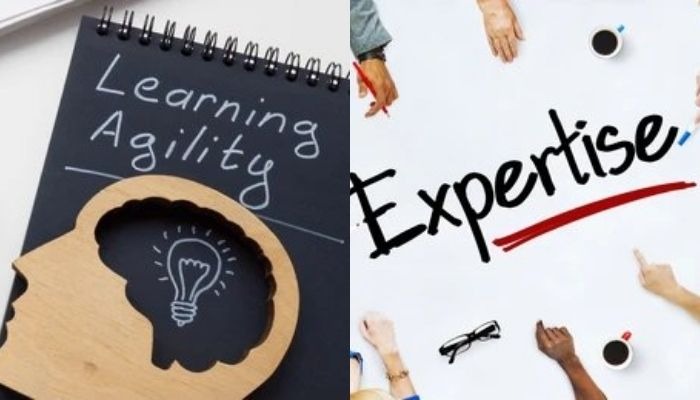
In today’s fast-changing workplace, broad knowledge alone is rarely enough to build lasting professional value. Deep domain expertise requires focused learning, deliberate practice, and continuous improvement. Professionals who combine specialization with adaptability are better positioned to make sound decisions, earn credibility, and remain valuable as industries, technologies, and expectations evolve.
Learning ability and deep domain expertise are not competitors. Rather, they are two different engines that power a career at two different speeds. One aspect gets you promoted when you have a well-defined job, while the other one gets you promoted when the job has not been invented yet.
This guide will break down the core differences between learning ability and domain expertise and determine which matters more in the long term.
In a rapidly changing professional landscape, the ability to keep learning and adapt may be just as valuable as deep expertise in a specific domain.
Let us first understand the conceptual difference between learning agility and domain expertise-
Before we explore its importance, let us first understand:
What is learning agility?
Learning agility is the ability and willingness to learn from experience, then apply that learning to perform well in new, unfamiliar, or first-time situations. It is not the same as being smart. It is not the same as being a fast reader or having a high IQ.
A person can have excellent learning ability under stable, familiar conditions and still have low learning agility the moment conditions change.
A widely used five-dimension model of learning ability, introduced by Korn Ferry, is presented below-
| Dimension | What It Measures |
| Mental Agility | Comfort with complexity, ambiguity, and unfamiliar problems |
| People Agility | Self-knowledge and the ability to work effectively with diverse people |
| Change Agility | Curiosity, appetite for new experiences, and comfort experimenting |
| Results Agility | Delivering results in first-time, tough situations and inspiring others to do the same |
| Self-Awareness | Accurate insight into personal strengths, limits, and blind spots |
Table 1: The Five Dimensions of Learning Agility (Korn Ferry Model)
A learning-agile professional tends to present signs of high learning agility at work by:
Now, let us turn to the other side of the comparison:
What is domain expertise, and how does it contribute to long-term success?
Domain expertise is deep, specialized knowledge and skill in one specific field. It is built through years of focused, deliberate practice and applied experience, not just years of general exposure.
An expert professional tends to show signs of deep domain expertise by:
A growth mindset can make domain expertise even more valuable by encouraging continuous learning, adaptability, and the willingness to deepen and update one’s knowledge over time.
These two terms get used interchangeably online, but they describe different layers of the same behavior.
| Aspects | Growth Mindset | Learning Agility |
| Definition | The belief that abilities and intelligence can be developed through effort | The demonstrated ability to learn quickly and apply it in new situations |
| Type | A belief system/mindset | A behavioral, applied skill |
| Where it lives | In how you interpret failure | In how you act when facing the unfamiliar |
| Can it be measured directly? | Indirectly, through self-report scales | Yes, through structured assessments and behavioral evidence |
| Relationship | The foundation | The practical output built on that foundation |
Table 2: Growth Mindset vs. Learning Agility
This is understood: a growth mindset is the belief that you can get better. Learning agility is the proof that you actually do get better, quickly, in situations you have never faced before.
You can hold a growth mindset and still have low learning agility if you never practice applying new knowledge under pressure.
Some fields cannot be substituted with adaptability alone. A surgeon, an aviation engineer, a tax auditor, or an ISO lead auditor needs thousands of hours of domain-specific, verified competence before judgment can be trusted. Both regulatory bodies and clients require it. In these fields, deep domain expertise is the entry ticket.
Which aspects matter more in the long term depends on the shape of the career you are building, and it changes over time.
Here is a career-stage framework to understand which aspect drives more success:
| Career Stage | What to Prioritize | Why |
| Early career (0-3 yrs) | Learning agility | You need breadth to find your strongest fit before committing to depth |
| Mid-career (3-8 yrs) | Balance, leaning toward one anchor skill | This is when T-shaped growth should start forming |
| Specialist track (8+ yrs) | Domain expertise | Deep mastery becomes your primary market value |
| Leadership track (8+ yrs) | Learning agility | Leaders must navigate problems outside their original specialty |
| High-disruption industries (AI, tech, digital) | Learning agility, refreshed constantly | Domain knowledge itself has a shorter shelf life |
| Regulated/high-stakes fields (medicine, law, audit, aviation) | Domain expertise, non-negotiable | Compliance and safety require verified, deep competence |
Table 3: Which Capability to Prioritize, by Career Stage and Field
Formal tools exist, including Korn Ferry’s Learning Agility Architect™ and the ViaEDGE self-report assessment, both widely used in enterprise talent programs. But you can run a useful, informal learning agility assessment on yourself right now using the same five dimensions.
In the self-assessment, you have to rate yourself between 1 and 5 on each-
Scoring guide: A score of 20-25 suggests strong, workplace-ready learning agility. 12-19 score suggests solid potential with specific gaps worth targeting. But a score below 12 signals that agility-building should be a deliberate, near-term development priority.
Building learning agility at work requires a deliberate effort to step outside your comfort zone, learn from experience, and continuously adapt to new challenges. Here are the required steps-
Building deep domain expertise requires sustained focus, deliberate practice, and continuous feedback to turn knowledge and experience into genuine mastery.
These are the core steps you need to follow-
Structured certification programs are one of the fastest, most credible ways to formalize domain expertise without waiting a decade for it to happen by accident. GIPMC’s certification tracks are built for exactly this.
Credentials from our platform compress fragmented, self-taught knowledge into a validated, internationally recognized credential. Programs like these anchor a specific vertical of deep expertise-
In addition, the applied, scenario-based format of GIPMC’s courses builds the adaptability layer at the same time.
Learning agility and domain expertise are often misunderstood, so it is important to separate common myths from what actually drives continuous learning, adaptability, and long-term growth.
Here are some common myths-
Learning agility is how fast you build depth when you choose to, not a reason to avoid depth altogether.
Expertise becomes a liability only when it is never refreshed. Refreshed expertise plus agility is the strongest combination available.
Learning agility is a trainable skill, built through practice, feedback, and reflection, much like any technical competency.
Mindset is necessary but not sufficient. Agility requires actually practicing rapid learning under real, unfamiliar conditions.
Learning agility and domain expertise are not competing capabilities. They complement each other at different career stages. Learning agility enables professionals to adapt, learn, and perform in unfamiliar situations, while domain expertise builds credibility and specialized judgment.
Long-term success comes from developing both, deepening expertise while continuously refreshing and expanding capabilities.
Whether you want to strengthen project management, business management, or AI capabilities, GIPMC helps turn knowledge into validated professional competence while developing the adaptability needed for a changing workplace. Explore the right certification and take your next career step!
Relying solely on narrow domain knowledge risks career stagnation, but GIPMC solves this through cross-domain certifications in Agile, AI, and strategic leadership. Our smart digital platforms and specialized certifications offer real-world skill transformation and continuous updates to ensure your credentials remain globally competitive and future-ready.
Self-taught agility often lacks official credibility, which our professional certification provider directly addresses with credentials aligned to international standards and recognized quality frameworks like ISO 9001:2015 and ISO 21001:2025. Furthermore, employers can immediately confirm your global standing through the online Credential Registry our platform has.
Rigid schedules make learning difficult, which is resolved by our platform through a Flexible Learning Approach with online, self-paced certification courses. Professionals can learn without geographic or time boundaries while earning credentials like the Professional in Program Management (PPgM) or Enterprise Agile certifications.
Deep technical knowledge alone risks obsolescence as automation spreads, but our certifications mitigate this fear through the Certified AI Foundation Professional (AIFP) and AI Product Manager Certification (AIPMC). These credentials help domain experts integrate AI capabilities, ethical governance, and cross-functional product management to keep their technical knowledge future-proof.
Generic online badges fail to validate real-world technical agility, leaving a major competency gap. Our platform solves this through exam-backed credentials like the Cyber Penetration Testing Professional (CPTP) and Artificial Intelligence Professional (AIP), providing formal, independently assessed evidence of actionable, hands-on technical skills.