The World Economic Forum’s Future of Jobs outlook projects roughly 170 million new roles created and 92 million displaced by 2030. This is a substantial gain. It requires workers building adaptable and cross-functional skills. The right certification can accelerate either path if you stack them strategically.
Career growth used to mean one thing: the next title up. That has changed.
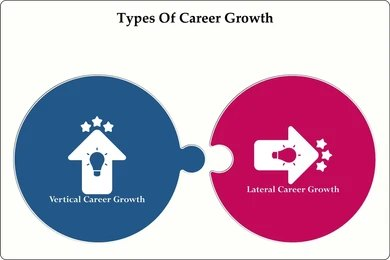
Today, two paths sit side by side. Vertical growth moves you up the ladder, with a new title, more authority, bigger paycheck. Lateral growth (also called horizontal growth) moves you sideways, with new skills, new function, wider exposure. Neither path is “better”. Each solves a different problem.
This guide breaks down both, shows you which certifications support each one, and gives you a simple framework to pick your next move.
Are you stuck trying to understand lateral growth vs vertical growth? Here is the answer.
Vertical growth in a career means moving up a traditional career ladder into roles with higher pay, titles, and leadership duties. Lateral growth in a career means moving sideways into new departments or roles at a similar pay grade to build a wider, versatile skill set. Both paths offer unique ways to improve your professional life.
Let us understand how each of them is a strategic approach to career development-
Vertical growth in a career is the traditional promotion path. You move from individual contributor to team lead, to manager, to director, to VP. Each step adds scope, authority, and compensation.
It is the model most people picture when they hear “career growth opportunities”: a clear ladder, a visible next rung, a title that tells the story.
Here are the core aspects that define vertical growth:
Example: A Software Tester becomes a Test Lead, then a QA Manager, then a Director of Quality Engineering. Same domain, growing authority.
The trade-off: as responsibility rises, so does pressure and the freedom to experiment often shrinks. Vertical growth rewards proven performance, not exploration.
GIPMC certifications that are built for vertical growth:
Explore all Leadership & Executive Management Certifications →
Lateral growth in a career (called horizontal growth in a career) means moving sideways rather than up. You shift into a different function, team, or specialization, usually at a similar level and pay grade, but your skill set widens.
There is no title bump, but a capability bump.
Here are the aspects that define lateral (horizontal) growth:
Example: A Business Analyst moves into UX research, then into product operations. The title looks similar on paper. The capability underneath is far more versatile.
The trade-off: compensation growth is usually slower at first. The payoff shows up later, as more marketable, cross-functional expertise that supports a bigger vertical jump down the line.
GIPMC certifications built for lateral growth:
Explore all Digital Product, Business Analysis & UX Certifications →
What are vertical vs lateral career growth?
Here are the core differences between vertical and lateral growth-
| Factor | Vertical Growth | Horizontal (Lateral) Growth |
| Direction | Upward, with new title, more authority | Sideways, with new function, similar level |
| Primary reward | Higher pay, bigger scope, formal status | Broader skills, adaptability, optionality |
| Speed of pay growth | Faster, tied to promotion | Slower initially, compounds later |
| Risk profile | Higher pressure to perform at scale | Higher short-term learning curve |
| Best for | Deep specialists ready to lead | Professionals building versatility |
| Common trigger | Strong track record in current role | Desire for new challenge or industry shift |
| Long-term signal to employers | "This person can run a function." | "This person can adapt across functions." |
| Typical certifications | Leadership, program management, executive AI | Business analysis, change management, cross-domain AI/digital skills |
Table 1: Vertical vs Horizontal Career Growth
Both horizontal and vertical growth in a career build professional effectiveness in 2026. The difference is what you are optimizing for right now: authority or adaptability. It matters in the current job market.
Hierarchies are flatter than they used to be. Skills go stale faster than they used to. Both facts push more professionals toward a hybrid strategy instead of a single-lane ladder.
Three shifts are driving this:
The practical result: career growth opportunities in 2026 rarely come from one ladder alone. They come from a mix of proven depth (vertical) and provable range (lateral), backed by credentials that make both visible on a resume or LinkedIn profile.
If your immediate goal is to step into that leadership tier, targeting the right credentials is the fastest way to signal readiness. Understanding horizontal and vertical career growth gives you the roadmap needed to stay resilient.
If your goal is the next title, like being team lead, manager, director, or executive, these certification categories map directly to that climb.
Here are the best certifications to get for career growth in a vertical path-
| Career stage | What you need to prove | Recommended GIPMC certification |
| Individual contributor → Team Lead | You can lead people, not just tasks | Certified Team Leadership Professional (CTLP) |
| Team Lead → Project/Program Manager | You can own delivery and outcomes | Project Management Certification (PMC), Professional in Program Management (PPgM) |
| Manager → Director/GM | You can run a function, not a project | General Management Diploma (GMD), Business Management Professional Certificate (BMPC) |
| Director → Executive (AI-driven functions) | You can set AI and technology strategy at the top | Certified AI Strategy Leader (CAISL), Chief AI Officer Certification (CAIOC) |
| Specialist → Portfolio-level authority | You can manage multiple initiatives, not one | Professional in Portfolio Management (PPfM) |
Table 2: Vertical Career Growth Certifications From GIPMC
View the full Global Project Leadership Certifications catalog →
If your goal is versatility, with a new function, a new industry angle, or a hedge against disruption, these categories build breadth fast.
Here are the best certifications for career growth in horizontal progression-
| Direction of move | What you need to prove | Recommended GIPMC certification |
| Operations → Strategy/Analysis | You can translate business problems into requirements | Business Analysis Foundation Specialist (BAFS), Professional Business Analysis Leader (PBAL) |
| Any function → Transformation/Change | You can help teams adopt new ways of working | Change Management Associate (CMA-G), Certified Change Management Professional (CCMP-G) |
| Technical → AI-adjacent | You can speak the language of AI without being an engineer | AI Literacy & Awareness Certification (AILA), Prompt Engineering Associate Certification (PEAC) |
| Marketing/Sales → Digital growth | You can run modern, data-driven campaigns | Digital Marketing Excellence Professional (DMEP), Sales & Marketing Strategy Consultant (SMSC) |
| Analysis → Product/Design | You can shape the user-facing side of the business | UX Architecture Specialist (UXAS) |
| Any function → Agile ways of working | You can operate inside cross-functional sprint teams | Business Scrum Mastery Credential (BSMC), Agile Product Ownership Professional (APOP) |
Table 3: Lateral Career Growth Certifications From GIPMC
The best-performing careers rarely pick one lane forever. They stack a lateral move with a vertical one, sometimes called diagonal growth: you widen your skill base, then use that breadth to justify the next promotion.
Here is a simple 3-step stacking model:
This is why “top certifications for career growth” rarely means a single certificate. It usually means a sequence. This one credential that broadens you, followed by one that elevates you.
Understanding the differences between vertical and lateral moves is only step one. The real impact comes from identifying which trajectory solves your current career equation.
Answer these five questions honestly. Mostly “A” answers point toward vertical growth. Mostly “B” answers point toward lateral growth. A mix means a hybrid path is likely your best move.
A) More authority and a bigger paycheck
B) New skills and more variety
A) Ready and motivated to lead a team
B) Prefer staying hands-on for now
A) Stable, with deep expertise is still the top currency
B) Shifting fast, as versatility is becoming the safer bet
A) Clear promotion tracks and visible titles
B) Internal mobility and cross-functional projects
A) A leadership credential or a bigger scope of ownership
B) A second skill area outside your current lane
If you have answered mostly A: Start with a leadership or program-management certification and pursue your next promotion directly.
If you have answered mostly B: Start with a cross-functional certification (business analysis, AI literacy, digital marketing, or change management) to widen your base first.
Even split: Plan a diagonal path, with one lateral certification this year and one vertical certification next year.
Whether you choose to climb upward or broaden sideways, missteps on either path can stall your momentum. Keep these critical pitfalls on your radar.
Here are the common mistakes in the vertical path to career growth:
Here are the common mistakes in the lateral path to career growth:
Whichever direction you choose, the credential behind it needs to hold up to employer scrutiny. GIPMC certifications are built for that:
Browse the Full GIPMC Certification Catalog →
GIPMC offers ISO-aligned, globally recognized credentials that bridge academic precision with real-world industry demands. It spans over 180 certifications across project leadership, AI, and digital transformation.
GIPMC empowers professionals to navigate both vertical leadership promotion and lateral skill broadening through flexible, self-paced, and transparently evaluated certification pathways.
Whether you are climbing into executive leadership or expanding your cross-functional capability, GIPMC provides the ultimate strategic advantage. Explore our ISO-accredited certification pathways today to future-proof your skills, validate your expertise globally, and take command of your next professional move!
GIPMC mitigates this risk through internationally aligned credentials accredited and backed by global standards like ISO 9001:2015, ISO 21001:2025, NASSCOM, and NSDC. Our verifiable Global Credential Registry ensures your lateral transitions carry trusted, worldwide authority across markets like the UK, USA, and UAE.
We address career obsolescence by incorporating an AI-driven smart digital learning platform and Continuous Education Units (CEUs). Our re-credentialing ecosystem allows vertical leaders to continually update their technical, AI, and management competencies.
We eliminate exam fear by utilizing transparent, outcome-based evaluations and scenario-based assessments designed by industry experts. Our certifications validate practical, job-ready application over theoretical memorization so you can perform confidently on day one.
We provide an extensive catalog covering 14+ specialized domain tracks. These range from Project Management (PMC) to AI, Cybersecurity to Agile Excellence. Our guided study resources and structured pathways allow you to customize both vertical leadership and lateral technical credentials from a single platform.
We provide a comprehensive catalog of over 180+ globally recognized professional certifications spanning project management, IT, cybersecurity, AI, and strategic leadership. This broad selection on our platform enables professionals to target specific vertical promotions or lateral cross-domain transitions from a single platform.