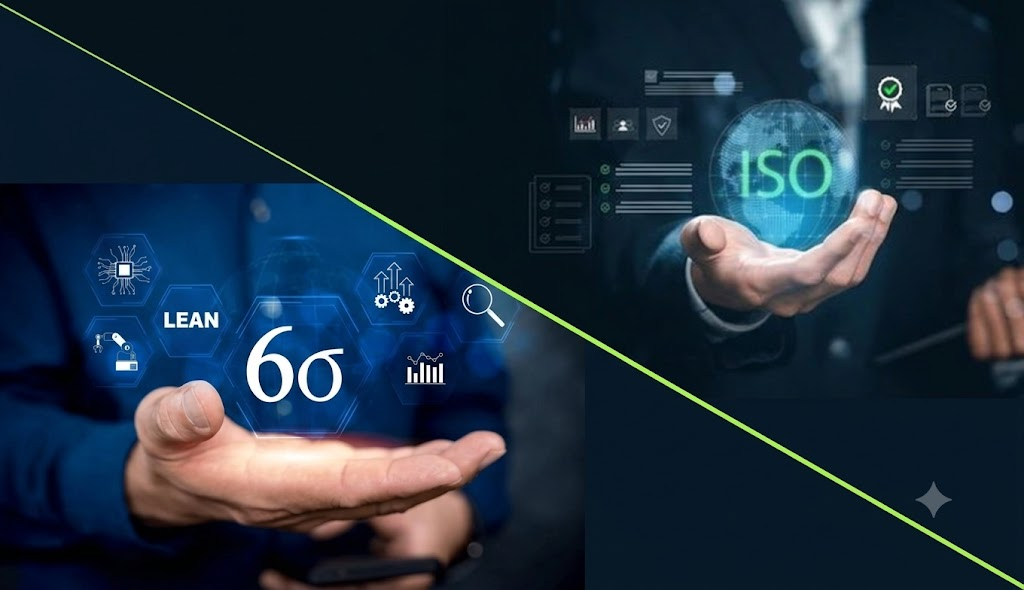
It is difficult to decide between Six Sigma and ISO 9001 when both terms are mentioned in a quality management job description. Indeed, both terms aim to improve quality, but they have different meanings. A wrong choice can cause a mismatch between your skills and your career goals.
Perhaps you have come across both terms in job listings. Sometimes they would appear in the same line: “Preferred experience: ISO 9001 and Six Sigma”.
The above-mentioned sentence could create a lot of confusion for those applying for quality management jobs. Are they the same? Do you need to have both certificates in order to find a job in this field?
This guide answers all of it.
Selecting the best quality management route could impact your career by building skills relevant to both your aspirations and the industry.
In order to compare Six Sigma and ISO 9001, the general principles of ISO 9001 need to be understood.
ISO 9001 is considered the best-known standard when it comes to establishing a quality management system. It has been published by the "International Organization for Standardization", which gives any organization guidelines regarding what needs to be implemented, but does not provide them with clarification on how to address a certain process.
Think of it as the architecture of quality, not the renovation crew.
Key facts about ISO 9001-
Now that you understand the fundamentals of ISO 9001, let us explore Six Sigma and how its process-improvement approach differs from a quality management system based on ISO 9001.
Six Sigma is a process that utilizes information to get rid of defects and to reduce variation in processes. It originated at Motorola, expanded at GE, and has since moved to practically every sector of operations management.
The goal is aggressive: no more than 3.4 defects per million opportunities (DPMO), an extremely tight tolerance for error.
Key facts about Six Sigma:
You may wonder-
How Is ISO 9001 Similar to Six Sigma?
The answer is, these two frameworks share more DNA than people expect.
Here is the direct answer to the question most people are actually searching for: What is the difference between ISO 9001 and Six Sigma?
Here are the core differences between ISO 9001 and Six Sigma-
| Factor | ISO 9001 | Six Sigma |
| What it is | A certifiable QMS standard | A process improvement methodology |
| Scope | Entire organization | One process at a time |
| Primary goal | Consistency, compliance, customer satisfaction | Defect elimination, variation reduction |
| Cycle used | Plan-Do-Check-Act (PDCA) | Define-Measure-Analyze-Improve-Control (DMAIC) |
| Governing body | International Organization for Standardization | No single global body |
| Certification type | Organization is certified; individuals earn Auditor/Implementer credentials. | Individuals earn belt-level credentials (Yellow, Green, Black, Master Black) |
| Best suited for | Building or auditing a quality system | Solving a specific, measurable performance problem |
| Statistical rigor | Does not require advanced statistical expertise | Heavy use of statistical tools and hypothesis testing |
| Typical roles | Quality Auditor, QMS Manager, Compliance Lead | Process Improvement Specialist, Operations Analyst, Lean Leader |
Table 1: ISO 9001 vs. Six Sigma at a Glance
The short version: ISO 9001 covers different aspects of quality management as a whole, while Six Sigma is a method for improving one process at a time. Neither replaces the other. They answer different questions.
Choose ISO 9001 if you-
Choose Six Sigma if you-
Choose both if you-
Career decisions run on numbers. A few honest caveats worth knowing before you invest in either path:
Indeed, for many quality professionals, this is a more sensible long-term approach instead of an either/or proposition.
This is a logical progression in stack order, as shown by how most quality careers progress-
1. ISO 9001 Internal Auditor- This level introduces you to what a quality management system (QMS) is all about in terms of how it is set up, documented, and audited. It is your first 'map'.
2. Six Sigma Yellow or Green Belt- This level provides you with the tools to do something about the problems uncovered during audits.
3. ISO 9001 Lead Auditor or Lead Implementer- This is the qualification that allows you to lead audits for certification or set up quality management systems from scratch, thus making you both consulting and leading.
4. Six Sigma Black Belt- This level makes you capable of conducting cross-company improvement projects.
5. The top two positions are Quality Director and Continuous Improvement Manager- these are supposed to know both methods.
This combination is exactly why Six Sigma is often used as one of the main methodologies for driving the process improvements required within an ISO 9001 quality management system. The two were never meant to compete for the same job.
Not every industry values these credentials equally. Use this as a quick check for where to invest first-
| Industry | ISO 9001 Weight | Six Sigma Weight |
| Manufacturing / Automotive | High | Very High |
| Healthcare & Life Sciences | High | Moderate-High |
| IT / Software | Moderate | Moderate |
| Logistics & Supply Chain | High | High |
| Financial Services | Moderate | Moderate-High |
| Food Production | High | Low-Moderate |
| Consulting / Professional Services | High | Moderate |
Table 2: Industry Relevance Guide
If your target industry sits in the “High/High” zone, holding both credentials early gives you a real competitive edge over single-credentialed candidates.
Ask yourself these three questions-
There is no wrong answer here. Both paths lead to respected, well-paid quality management careers. The only mistake is picking neither.
GIPMC offers globally recognized certifications across both paths, so you can start where your strengths are and expand from there.
ISO 9001 track:
Six Sigma / Lean track:
Aiming for the top of the field? Explore the Quality Management Leader (QML) and Quality Management Director (QMD) credentials, built for professionals combining both disciplines.
ISO 9001 and Six Sigma are not rival concepts. Rather, they are tools that deal with separate problems for separate objectives belonging to various jobs. ISO 9001 creates and certifies the scheme while Six Sigma mends what needs repair in this organized plan.
Therefore, your decision should rest on the place you are going to occupy in the quality department: at the system level, at the level of processes, or perhaps at both levels.
If you are feeling stuck in your quality career, an ISO 9001 Lead Auditor or Lead Implementer Certification can help you build the practical knowledge and confidence needed to take the next step.
These programs strengthen your skills in process management, risk-based thinking, and audit management, preparing you for roles such as Quality Manager, QMS Consultant, or Lead Auditor.
We tackle stagnant careers through our top-notch, focused programs, including ISO 9001 Lead Auditor and ISO 9001 Lead Implementer Certifications, tailor-made for our clients' professional development. These programs will help you develop the competencies necessary to advance into positions such as Quality Manager, QMS Consultant, or Lead Auditor.
Choosing either framework will not stall your career when backed by our globally benchmarked certifications, such as the certified Lean Yellow Credential (LYC) and ISO 9001 Lead Implementer / Auditor programs. We guarantee global relevance, ISO 21001:2025-aligned educational standards, and smart digital platforms with digitally verifiable certificates so employers worldwide immediately recognize your expertise.
You do not need to fear complex prerequisites because we design practical, industry-aligned learning pathways that combine academic rigor with real-world applications. Our smart digital platform utilizes AI-based assessments and structured step-by-step guidance to ensure you build job-ready skills regardless of your starting technical level.
We address this gap by rejecting “participation-only” badges and focusing on real-world skill transformation through practical, industry-focused learning. Their programs equip you with actionable methodologies, from root cause analysis to process mapping and QMS deployment, that deliver immediate, measurable results in your workplace.
You will not fall behind because we collaborate directly with professional quality management forums worldwide to continuously update curriculum standards. Through the Lifelong Professional Ecosystem, we provide members with structured renewal pathways and continuous learning updates to keep credentials perpetually relevant.