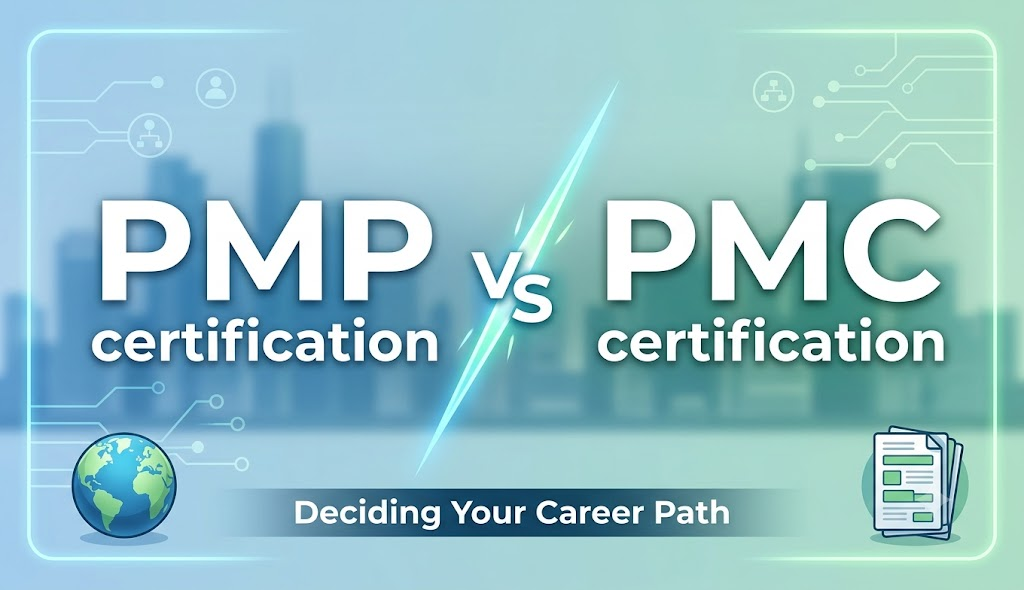
PMP leads in US and global corporate markets, while GIPMC PMC delivers a vendor-neutral, methodology-agnostic credential with a 30–45% earning uplift and no steep prerequisites.
Every project management professional hits the same wall: which certification actually moves the needle on your salary, your credibility, and your career options? The debate over traditional corporate certifications vs. flexible, modern credentials is real- but neither credential fits every career stage on its own.
GIPMC PMC has quietly emerged as the second option that most comparison guides ignore. And for good reason - it fills the gaps that PMP leaves open.
According to a report by BusinessWire, PMI's Earning Power Survey revealed that certified project managers earn 33% more than their non-certified peers across 21 countries. The Global Project Management Software Market is projected to grow from $7.4 billion in 2023 to $20.5 billion by 2030, with demand for certified professionals rising in parallel. (Source: PMI / Grand View Research)
The first step in any project management certification comparison is understanding what each credential actually measures - not just what the marketing says.
| Feature | PMP (PMI) | GIPMC PMC |
| Approach | Leadership + knowledge-based (PMBOK 8th ed., 2026) | Methodology-agnostic; real-world execution |
| Origin | USA (PMI) | Global (GIPMC) |
| Framework | PMBOK-aligned; hybrid-ready | Industry-aligned competencies, vendor-neutral |
| Agile integration | Yes (built into exam 2026) | Yes - framework-agnostic by design |
| Best for | Corporate, tech, US/Asia/ME market | Multi-industry; global flexibility |
| Renewal | 60 PDUs / 3 years | Structured recertification cycle |
Table 1: What PMP and GIPMC PMC Measure
Comparing the earning impact of PMP and GIPMC’s PMC comes down to corporate dominance versus global versatility. PMP commands top-tier absolute salaries in regions with heavy US corporate footprints, while GIPMC’s PMC delivers a consistent earning uplift across diverse sectors and international markets without geographic limitations. Here is what the 2026 data shows:
| Market / Region | Base Project Manager Salary (Non-Certified USD) | PMP Average Salary Range (USD) | PMP Certification Premium (%) | GIPMC PMC Estimated Uplift / Range | Primary High-Paying Industries & Demand |
| United States | $95,000 - $105,000 | $125,000 - $138,000 | +25% - 33% | 30% - 45% over baseline ($135K - $155K+) | IT/Software, Consulting, Energy, Healthcare |
| United Kingdom | $70,000 - $80,000 (£55K - £63K) | $95,000 - $115,000 (£75K - £90K) | +20% - 28% | 30% - 45% over baseline ($110K - $130K) | Financial Services, Defense, Infrastructure |
| Middle East / GCC (UAE, KSA, Qatar) | $70,000 - $85,000 | $95,000 - $130,000 (Tax-Free Equivalent) | +28% - 38% | 35% - 50% over baseline ($125K - $160K+) | Mega-Infrastructure, Energy/Oil & Gas, Public Sector |
| EU / Public Sector (Germany, Nordics, EU Govt) | $65,000 - $78,000 (€60K - €72K) | $85,000 - $110,000 (€78K - €100K) | +18% - 25% | 25% - 40% over baseline ($100K - $125K) | Automotive, Public Sector/Govt, Green Energy |
| Asia-Pacific (Singapore, AU, India) | $45,000 - $70,000 (Regionally Weighted) | $65,000 - $110,000 | +22% - 35% | 30% - 45% over baseline ($80K - $125K) | Tech Hubs (Singapore/Bangalore), Telecommunications |
Table 2: PMP vs. GIPMC PMC Salary Comparison
Key Insight: PMP commands high absolute salary figures, particularly in markets dominated by North American corporate structures. However, PMC's 30-45% earning uplift applies globally across multiple industries, making it the more geographically versatile option if you plan to work across different regions or switch sectors.
Project management certification cost is the most underestimated factor in the decision. Here is the full breakdown - exam fee, training, renewal, and total investment:
| Cost Component | PMP (PMI) | GIPMC PMC |
| Exam Fee | $405 members / $555 non-members | Contact GIPMC directly |
| Training Cost | $800–$3,000 | Structured e-course included |
| Total Investment | $1,100–$3,500 | ✓ Lower barrier |
| Renewal Cost | 60 PDUs / 3 years (~$60–$150) | Structured recertification |
| Prerequisites | 36–60 months PM experience + 35 hours education | Multiple career stages supported |
| Time to Certify | 6–12 months (prep + eligibility) | Flexible - self-paced e-course |
Table 3: PMP vs. GIPMC PMC Cost
Bottom line: PMP carries a higher total project management certification cost and the steepest eligibility bar. GIPMC PMC sits in the accessible tier - providing global validity without the prerequisites or high price tag.
Deciding which project management cert is worth it for your situation depends on three variables: your current experience, your target industry, and your geographic market. This table maps the answer:
| Your Situation | Best Certification | Reason |
| No PM experience; want to start now | GIPMC PMC | Low entry barrier; structured foundation without experience lock-out |
| 5+ years' experience; targeting US or global corporate | PMP | Highest salary premium in North America, Middle East, and Asia-Pacific |
| Multi-industry or changing sectors | GIPMC PMC | Vendor-neutral; applicable across IT, construction, finance, healthcare |
| Beginners needing structured, accessible training | GIPMC PMC | Best project management certification for beginners with global applicability |
| Seeking a PMP alternative with global validity | GIPMC PMC | Internationally recognised project management cert without PMP's steep prerequisites |
Table 4: Certification Suitability: PMP vs. GIPMC PMC
The PMC certification by GIPMC is built differently from PMP. It is not tied to a single framework, a single methodology, or a single geography. That is the point - and in 2026, the advantage.
PMP vs GIPMC PMC is not about which certification is universally 'better'- it is about what matches your career goals. PMP wins in high-barrier US and corporate markets. GIPMC PMC wins for professionals who need a globally applicable, methodology-agnostic credential without PMP's steep prerequisites or total cost.
Stop debating which project management cert is worth it and start building the credential that works for your goals - globally, across industries, and without the barriers. GIPMC's PMC is designed exactly for that.
Yes. While PMP holds strong brand awareness in US-centric corporate markets, PMC is built to be vendor-neutral and framework-agnostic. This design ensures that PMC certification is recognized across global markets- including Asia-Pacific, Europe, the Middle East, and the Americas- without being restricted to a single country's governance framework.
GIPMC PMC is delivered via a structured e-course that you can complete at your own pace. Most professionals complete preparation within 4–12 weeks, depending on prior experience. The flexible format suits working professionals who cannot commit to full-time study schedules.
GIPMC PMC and PMP serve different strategic purposes. PMP has greater name recognition in large US and global enterprises. GIPMC PMC is positioned as an internationally recognised project management cert with real-world applicability across industries - making it highly valuable for professionals in sectors like healthcare, construction, IT services, and manufacturing.
Yes - this is one of PMC's strongest use cases. Because GIPMC PMC supports multiple career stages and has no rigid experience prerequisites, it is one of the most accessible project management certifications for professionals transitioning from technical, operational, or administrative backgrounds.