
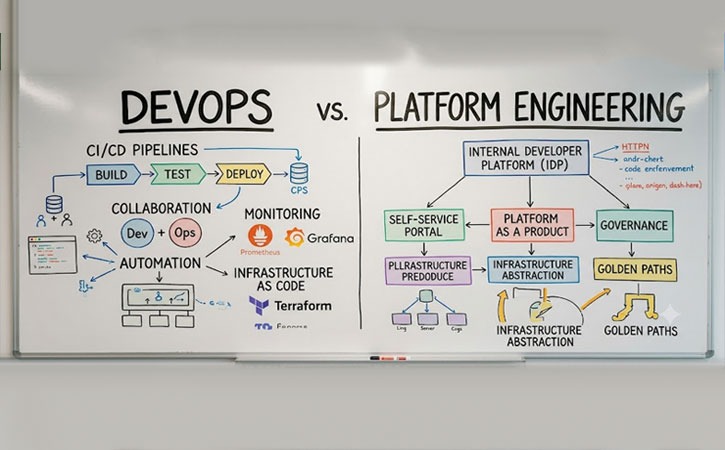
Both DevOps and platform engineering use agile software development methods. DevOps, a cultural phenomenon, focuses on breaking down silos for software delivery, while Platform Engineering stands for a specialized discipline implementing DevOps principles.
DevOps is a revolutionary system that merges operations and development, while platform engineering refers to the discipline of developing internal platforms (IDPs). While DevOps defines how teams collaborate, platform engineers offer the tools for enabling collaboration and reducing cognitive load.
But how do they differ functionally? What’s the difference between their core principles of working? Let’s explore here.
DevOps stands for a collaborative set of practices and a specific suite of tools, which are designed to merge software development (Dev) and IT operations (Ops). The primary objective of the DevOps platform is to minimize the system development lifecycle and ensure a continuous delivery of high-quality software.
So, what is a DevOps lifecycle? Also, what are the relevant tools and practices, prioritized by DevOps engineers? Let’s find out.;
Here are some of the key practices and tools relevant to DevOps.
DevOps bridges development and operations through automation, continuous integration, shared responsibility, and rapid feedback, fostering collaboration to deliver software faster. DevOps’ core principles - culture, automation, measurement, and sharing (CAMS), focus on bridging operations and development, to deliver software faster and collaboratively.
Here are some key details about the core principles of DevOps.
DevOps Foundation Analyst (DOFA) certification offered by GIPMC can be the best option to explore better opportunities in the global IT market.
Platforms engineering stands as the discipline of building and designing Internal Developer Platforms (IDPs). It offers self-service capabilities for software engineers, and its primary goals to minimize the cognitive load from developers’ responsibilities. In this regard, it abstracts away the critical and complex aspects (such as CI/CD pipelines and Kiberneres clusters) of contemporary cloud-native infrastructure.
But, why is it trending? How is platform engineering sustainable? Let’s find out.
A Gartner study finds that by the end of 2026, 80% of large and global software organizations will have in-house platform engineering teams for reusable services - a steady increase from 45%, as of 2022.
So,what’s the reason behind platform engineering being a trend in 2026?
Platform engineering solves the complexities of cloud-native development with internal developer platforms. The self-service enhances productivity and security, and boosts the speed of software delivery.
But, how does the trend sustain? What are the responsibilities of platform engineers, and what are they expected to meet? Let’s find out.
Between 2024 and 2030, it is expected that the global platform engineering market will reach $23,908 million, at a CAGR of 23.7%. The number suggests the increasing market popularity of platform engineering, and in this regard, roles and responsibilities of platform engineers play a key role.
Here are the key responsibilities of platform engineers:
Here are the core principles of platform engineering:
Platforms do not show the complexity of their infrastructure, and instead of that they are found with simplified interfaces. With automation and extraction, platform engineering fosters a self-service internal developer platform, and enables developers to focus on delivering business value and writing codes.
Platforms offer golden paths, with standardized workflow. It allows teams to work faster without any strict constraints, adhering to the best practices. Moreover, the security of platforms ensures the enforcement of automatic policy, compliance, and audit logging.
Platforms are designed and engineered with stable functionality. Moreover, they are scaled with organizational requirements that ensure consistent performance during the enhanced workloads.
Contact GIPMC for Secure Software Testing Specialist (SSTS) Certification to improve your skills and knowledge in platform engineering.
Since now we know what DevOps is, along with its core principles, and what platform engineering stands for, focus on their differences. Check the table below to know the contrast between them.
| Aspect | DevOps | Platform Engineering |
| Primary Focus | Culture, collaboration, and process optimization between Dev and Ops. | Developing Internal Developer Platforms (IDPs) as a product. |
| Core Goal | Faster software delivery, and shared ownership. | Enhanced developer productivity, standardization, and self-service. |
| Approachr | Process-oriented, and it breaks down silos. | Product-oriented, treats the platform as a product. |
| Audience | Software developers, ops personnel, and system admins. | Application developers (internal customers). |
| Key Output | CI/CD pipelines, monitoring setups. | Internal Developer Portals (such as, Backstage), Golden Paths, and self-service APIs. |
| Developer Autonomy | High, but developers manage their own infrastructure. | High, through self-service tools, abstracting infrastructure. |
Table: Differences between DevOps and Platform Engineering
Improve your IT skills and knowledge in DevOps and platform engineering with GIPMC certifications. Get useful guidance to pursue the best certifications as per your professional requirements.
Yes, platform engineering and DevOps can work together, and they are complementary in nature. DevOps offers a cultural shift of shared responsibility and automation, while Platform engineering develops standardization and self-service tools to scale DevOps practice across an organization.
Shift left in DevOps implies quality and security assessment at the early stage of the software development lifecycle (SDLC). It aims to prevent early defects, which accelerate delivery and reduce costs, along with a proactive collaboration between testers, developers, and operations.
Success in platform engineering is measured by improving operational stability, productivity, and operational stability. The key metrics are developer satisfaction, DORA metrics, and reducing infrastructural costs.
DevOps adoption challenges primarily arise from skill shortages, cultural resistance, and infrastructural complexity, instead of tooling issues. The key issues include upskilling staff for automation practices, cloud management, security, and integrating legacy systems.
The key challenges of adopting platform engineering include the need of specialized expertise and high cost for the initial setup. Engineers prioritize executive support, a phased implementation approach, clear communication, and training.