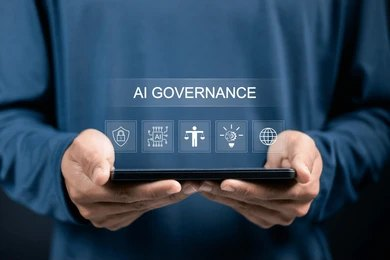
The AI Governance Officer establishes the required standards for AI compliance in corporations. With every sector of modern organizations involving AI functionalities, the AI governance officer’s role is to oversee the ethical, regulatory, and risk management obligations of the organization around artificial intelligence.
With the increasing adoption of AI, organizations heavily rely on AI Governance Officers to ensure that their AI systems are compliant with international AI laws, ethical and transparent, and compliant with corporate and regulatory requirements.
The AI governance officer is an emerging role within corporate leadership that focuses on ensuring the legal and ethical use of artificial intelligence. AI governance officers create a link between technical teams developing machine-learning models, legal departments ensuring compliance with regulations, and the executive team for overall strategy. Certified AI practitioners will ensure that all developed machine-learning models comply with the stated purpose and are consistent with company values and behaviors.
The role of an AI governance officer is to understand how organizations will mitigate algorithmic risk and protect the privacy of their data. AI governance officers will create policies to govern the use of algorithms, establish processes for measuring the impact of algorithms, and determine the appropriate thresholds for making automated decisions. AI governance officers lead responses to situations where algorithms generate biased results or violate the terms of use for data.
| Functional Metric | AI Governance Lead | Chief AI Officer (CAIO) | AI Compliance Auditor |
| Primary Focus | Ethical guardrails, policy frameworks, and risk mitigation | Enterprise AI strategy, commercial scaling, and ROI | Technical system audits and direct regulatory compliance |
| Typical Target | Mitigating bias and preventing systemic legal liabilities | Driving corporate growth and product integration | Verifying software aligns with state laws |
| Core Output | Model Risk Assessment Reports | Generative AI Implementation Blueprints | Algorithmic Audit Certificates |
Table: Functional Metrics for AI Governance Roles
If you are somebody pursuing a career in AI compliance, you will benefit greatly from having a background in fields like computer science, corporate and/or regulatory law, information security, data protection operations and auditing, or data privacy. If you have a background in data privacy, risk management, or system auditing, you can easily transition into working specifically with AI compliance.
After developing adequate experience in your domain, you can complete an AI governance certification program to develop targeted knowledge in global regulations governing AI systems. This will not only help you build your knowledge and skills in the area but also give you the necessary credentials to move into more senior governance roles in AI compliance.
With a top AI risk management certification in your kitty, hiring managers will know that you are competent at handling AI governance responsibilities. Hence, opting for an AI governance certification in 2026 can be a very smart move. The only thing you need to determine is which certification programs to opt for.
Your choice of AI governance certification will depend on your current role and career path. The top certification programs include:
The chief AI officer certification will validate your skills in balancing corporate risk with technological growth, preparing you to lead multi-departmental technology boards.
An AI ethics certification online will provide you with a deep understanding and quality training in identifying and mitigating model bias, teaching you how to design and enforce non-discriminatory guidelines across diverse networks.
Acquiring an AI risk management certification will enable you to manage unanticipated behaviors from machine learning, apply international safety standards, and safeguard corporate infrastructure.
Consider AI auditor certification if you would like the capability to assess the compliance of algorithms operating internally to determine if they are adhering to local privacy and data usage laws through forensic audits of active machine learning pipelines.
A responsible AI certification will allow you to demonstrate a broad, holistic understanding of ethical system deployments, strengthening your ability to align technological developments directly with human safety standards.
The Global Institute of Professional Management Certification (GIPMC) provides global benchmarked, platform-neutral training programs ideal for modern-day leaders. Our structured curriculum gives professionals practical, strategic skills that they can continue to use in their current careers while simultaneously preparing for a career in AI governance.
We don’t just help you find the answer to what does an AI governance lead do, but our programs are also designed to help you adopt and excel at real-life skills in daily tasks. Our programs align with the latest global standards and will ensure that your credentials will have an immediate impact when entering the corporate world.
Connect with us today and find the best AI compliance officer career path for you. Explore our accredited professional programs and put yourself in a position for long-term strategic career success!
Data governance is concerned with the management of data assets, while artificial intelligence (AI) governance focuses on how AI systems are developed/designed, deployed, and monitored.
Yes. The EU AI Act has an extraterritorial scope of application; this means that any company that deploys/runs an AI model that impacts European citizens, regardless of the company’s location, is required to comply with the strict regulations of the EU AI Act.
Absolutely. Project management, stakeholder cohesion, and organizational governance skills can often be successfully transitioned into other areas. However, it should be noted that jobs in AI governance require continuous learning because AI technologies/concepts, regulations, and industry standards are evolving at a very fast pace and will continue to do so.
Generally, credentials are good for three years from the date of issuance. Retaining an active status for the certification requires completion of Continuing Professional Development (CPD) credits or the completion of refresher modules in a designated subject area.
No formal educational prerequisites are required for the GIPMC AI Governance certification programs. However, a background in business administration, law, or data analysis will greatly assist you in understanding the complexity of the regulatory material.