Organizations of all kinds use digital platforms, cloud-based services and applications, and other systems to conduct their business. As more information is stored digitally, the protection of valuable information and the digital infrastructure becomes increasingly important.
Traditional methods of cybersecurity will still be used, but determining whether something is suspicious may be difficult when dealing with large amounts of information. Security teams can benefit from using artificial intelligence to aid them in analyzing large datasets and identifying abnormal behavior.
On the other hand, criminals can also benefit from artificial intelligence to assist them in the planning and creation of attacks. AI can even be used to mimic real people to increase the chances of persuading a target to disclose sensitive information.
By gaining a greater understanding of AI, companies can protect their digital information, systems, and employees from cyber threats.
AI in cybersecurity is the use of different artificial intelligence technologies to help identify, analyze, and respond to various security threats. It is used to protect different computer systems, networks, applications, cloud environments, and other business information.
Traditional security methods rely on pre-defined rules and threats that are known. AI can analyze larger sets of information to determine behavior that may not be rule-based.
To cite an example, suppose there is an employee of the organization who accesses information from a particular location during working hours. Then, that same employee attempts to access information from a different location at a time when the employee is not working.
An AI-based system may identify this behavior and flag it as suspicious.
AI won’t necessarily reveal that an attack is occurring. It can, however, help security personnel compile information on potentially threatening situations.
There are several areas that are becoming key factors.
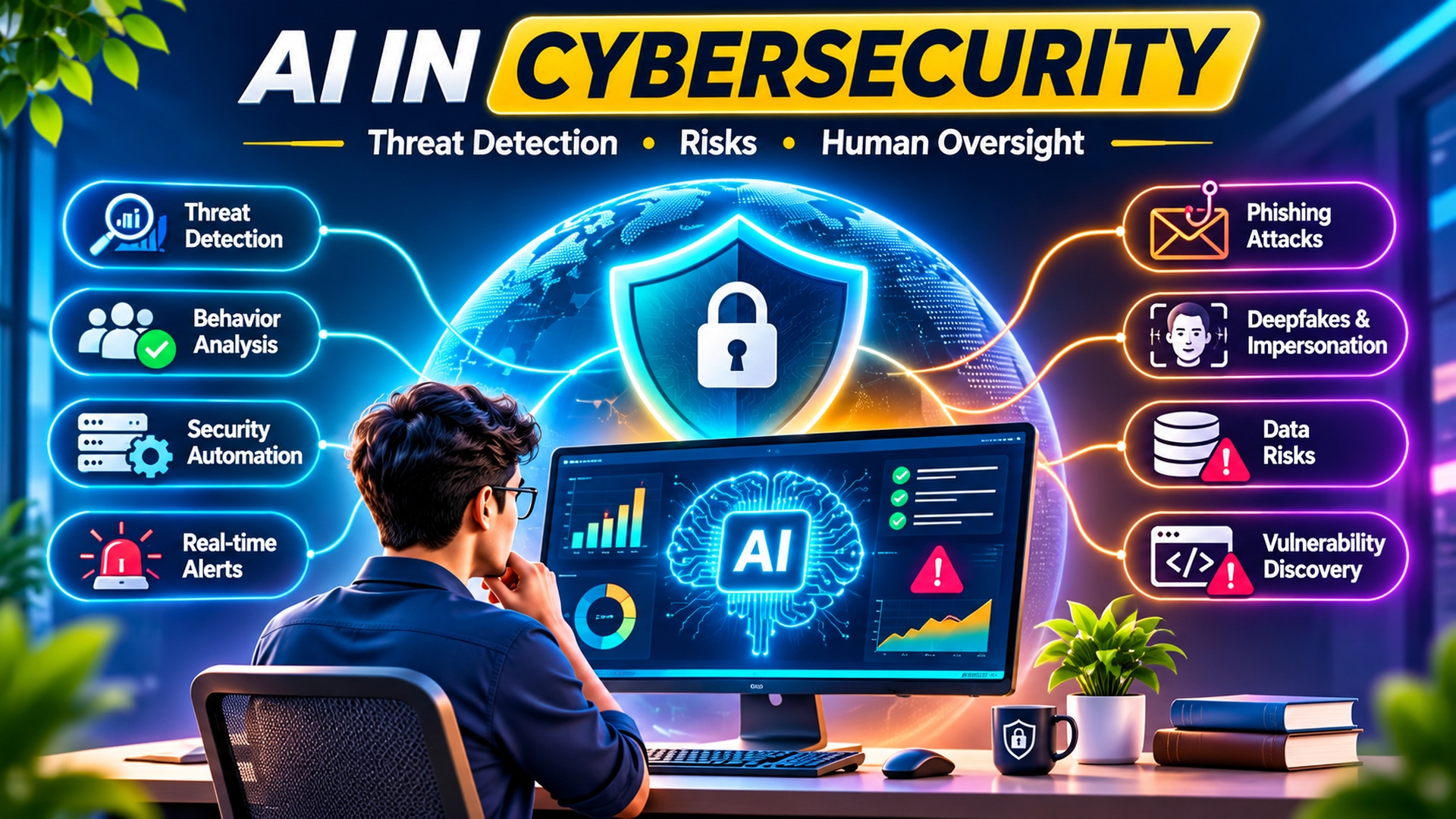
AI-Powered Threat Detection
One of the most well known areas is the use of AI to detect threats. Today’s businesses produce massive amounts of security data via the networks, applications, and cloud environments that employees use.
Using AI tools to analyze this data can help security teams identify malicious activity, including fraudulent logins, unusual spikes in network traffic, and other risks.
AI can also help security teams automate repetitive tasks, especially when sorting through large volumes of data.
Using AI to analyze behavior is growing within the industry. There are several facets to malicious behavior including anomalous activity, suspicious communication, unauthorized access, and unusual file transfers.
AI can sort data and help identify various threats, including malicious insider behavior, but not every odd or unusual activity is malicious. AI can help security teams identify suspicious behavior, but ultimately the final decision will be up to a security team member.
AI is helping security teams analyze data and highlight important information to aid in identifying threats.
There is a lot of information regarding various threats and attack methodologies. Finding and categorizing all of this information can be difficult. AI can help automate this process and allow security teams to strategize the best way to defend against threats.
This provides organizations with the ability to identify security risks and determine what requires attention.
Many repetitive tasks are done by security team members, such as alert review, collection of information required for the investigation, and the preparation of incident response reports.
Automation and AI are able to perform these tasks more effectively by organizing alerts and providing summary information for security incidents.
This would allow security professionals to spend more time on investigation of complex security incidents.
AI can help cybercriminals be more effective by assisting them with automating more convincing attacks.
Phishing is a very effective attack used to trick people into sharing their sensitive information.
In the past, creating convincing emails to help perpetrate phishing attacks often required a significant level of effort. Using AI, cybercriminals can now create thousands of phishing emails that appear to come from different legitimate people or organizations.
Given the advances in AI, it is becoming increasingly difficult for people to recognize phishing emails based on poor language or grammar.
AI can help create deepfakes that represent a real person’s image, voice or videos.
Employees may receive a deepfaked voice message that appears to be from a real person directing them to perform a task. Employees may unknowingly perform this task if they did not adequately verify the request.
AI and automation make deepfakes easier and less expensive to create. Therefore, organizations need to verify the identity of people requesting sensitive tasks be performed.
It’s likely that cybercriminals will start using AI tools to analyze software and systems to research potential weak points. These activities can assist various steps in an attack process. However, using AI to research potential vulnerabilities does not guarantee that a system can be compromised.
Continuous updates to software, performing vulnerability assessments and configuring systems correctly are still essential.
The International AI Safety Report 2026 describes how AI can help automate elements of planning a cyberattack and helps explain the challenges in predicting the impact AI will have on the overall number and severity of attacks.
When using AI in security processes, organizations must also recognize the associated risks.
Employees may inadvertently have confidential business and customer information processed by an AI application.
Staff must be educated as to the kinds of information that can and cannot be processed by AI applications.
Prompt injection occurs when instructions to subvert the AI system are included in the information that the AI processes. If an AI is granted extensive access, such as to business documents, systems, and applications, the impact of a prompt injection attack may be extensive.
AI systems can misclassify data, which can result in a security system falsely flagging innocent behavior as malicious.
Security personnel should review and validate the AI system’s recommendations and findings.
Some AI applications can interact with connected tools, files, and business systems.
Increasing the permissions of an AI application elevates the risk posed by a security weakness or misuse.
The principle of least privilege requires that access is provided only to the information and functions required by the AI system to perform its task.
Businesses need to understand their existing security needs and identify the areas where AI can provide practical assistance.
AI can help with security alert triage and prioritization. For businesses where the number of security alerts issued is very high, AI-supported alert triage and prioritization can ease the burden on security personnel by automating the process of determining which alerts require attention.
Other AI tools exist to help with user behavior, security incident and event management, threat intelligence and incident response.
When assessing these tools, organizations should evaluate how well the tools help address the requirements of the security and data protection processes, the level of integration required, and how well the tools help automate tasks, provide audit trail and logs. Staff should be educated about the use of AI to further automate security, and employees should understand the importance of security and data protection and AI's role in assisting these processes. AI can help in suggesting possible solutions, recommendations and case support. However, to make the final decisions, human inputs should not be replaced.
The role of AI in automating security will only continue to increase. Organizations are beginning to automate security functions like threat detection and response using AI.
One developing area is agentic AI. Beyond offering suggestions, AI agents can connect to other applications and services to perform a series of tasks to achieve a goal.
In security operations, this may include retrieving case information and reviewing alerts and suggesting various courses of action. Autonomous agents increase the risk of attack surface, and thus raise questions about how to best exercise control over them, e.g., through policy, procedures and/or means of assurance.
Some recent research has shown how adversaries are using AI to assist with planning and execution of attacks, as well as identifying AI systems as potential targets.
This means that security organizations will need to protect the systems and AI applications that they use.
Thinking about the future of cybersecurity, there will be a need for integration of different skills and technologies, including the combination of AI with data protection, identity management, cloud security, automation, and human skills.
There are opportunities for cybersecurity professionals to enhance their knowledge and skills, including through the AI in Cyber Defence Specialist (AICDS) Certification. Through this, professionals will be equipped with the skills to defend against sophisticated AI cyber attacks.
AI is helping organizations evolve how they protect themselves against threats in an increasingly complex environment.
Curbing bad actors is not as important as addressing the impact AI has on your workforce. To keep up, your organization will need to build strategies and invest in tools to build, select, and reinforce appropriate AI cybersecurity methods, and train your staff to recognize and manage the risks.
As AI techniques evolve and become more commonplace, it will become critical for organizations to have individuals who understand AI in cybersecurity in order to protect their digital infrastructures.
AI in cybersecurity is the use of AI to protect network, applications, and IT infrastructure by detecting threats and ensuring the confidentiality, integrity, and availability of business information.
AI is used in IT and network security to analyze traffic and identify account activity to help build threat intelligence and support security personnel with repetitive tasks in an investigation.
Prominent threats include AI-generated phishing, deepfake impersonation, data exposure, prompt injection, excessive permissions, and inaccurate AI recommendations.
AI cybersecurity tools are software programs that incorporate artificial intelligence and machine learning to assist security teams with threat detection, network traffic analysis, malware identification, vulnerability assessment and management, and incident response.
AI will not displace cybersecurity workers. AI can automate repetitive tasks and help users retrieve and investigate additional information, but there will still be a need for employees to analyze threats, evaluate recommendations, and make important security decisions.
AI can assist employees in sorting through large amounts of security-related data, identify unusual activity, and provide support for security functions. Responsible use of AI in the workplace can benefit an organization's cybersecurity strategy.
Take a look at the AICDS certification offered by GIPMC to take your understanding of AI and cyber defence to the next level.