Course Description
Engineer Quality, Integrate Testing & Enable Reliable Software Delivery
The Software Quality Engineering Specialist (SQES) certification is a professional credential designed to develop, validate, and recognize advanced quality engineering capabilities that integrate testing, automation, process discipline, and engineering best practices.
This certification emphasizes quality engineering mindset, test automation, continuous testing, defect prevention, and collaboration across development and operations, preparing professionals to ensure quality is engineered into software from design to deployment.
SQES goes beyond traditional QA roles. It equips specialists with the ability to embed quality into engineering workflows, apply automation strategically, analyze quality risks, and support fast, reliable, and scalable software delivery.
Why Software Quality Engineering Specialist (SQES) from GIPMC?
The SQES certification is technology-agnostic and delivery-model flexible, enabling professionals to apply quality engineering principles across agile, DevOps, and hybrid environments.
Key Advantages
- Globally relevant software quality engineering framework
- Balanced coverage of testing, automation, engineering practices, and governance
- Practical, scenario-driven learning aligned with real delivery pipelines
- Applicable across web, mobile, enterprise, cloud, and API-driven systems
- Career-oriented certification focused on prevention-first quality engineering
SQES supports professionals operating at specialist and senior quality engineering levels.
Market Relevance
Organizations increasingly adopt quality engineering to reduce defects, accelerate delivery, and improve customer trust.
- 40–60% reduction in production defects through quality engineering practices
- 70%+ hiring preference for professionals with quality engineering and automation expertise
- 45–55% improvement in release stability with integrated testing and automation
- 2× faster feedback cycles compared to traditional QA-only approaches
(Based on aggregated quality engineering adoption, DevOps performance, and software delivery benchmarks.)
These indicators highlight why software quality engineering skills are critical in modern development environments.
Who Should Pursue SQES? (Target Audience)
The Software Quality Engineering Specialist certification is designed for professionals responsible for engineering and sustaining software quality, including:
- Quality Engineers and QA Automation Specialists
- Software Test Engineers transitioning into quality engineering roles
- DevOps and Continuous Testing Practitioners
- Software Engineers with quality ownership responsibilities
- QA Leads and Quality Engineering Managers
- Professionals moving from testing into engineering-focused quality roles
SQES establishes a shared engineering-quality framework across development, QA, and operations teams.
Detailed Learning Outcomes
By earning the Software Quality Engineering Specialist (SQES), candidates demonstrate competencies consistent with a CAPM project management certification, including the ability to:
1. Foundations of Software Quality Engineering
- Quality engineering vs. traditional QA
- Role of quality engineers in modern delivery
- Quality as an engineering discipline
2. Software Development Lifecycle & Quality Engineering Integration
- Quality engineering across SDLC models
- Shift-left and shift-right testing concepts
- Collaboration across teams
3. Requirements Quality & Risk Analysis
- Ensuring requirement clarity and testability
- Identifying quality risks early
- Traceability and impact analysis
4. Test Strategy & Quality Engineering Planning
- Designing scalable test strategies
- Balancing manual, automated, and exploratory testing
- Risk-based quality planning
5. Test Automation Engineering Fundamentals
- Automation architecture and design
- Selecting appropriate automation levels
- Building maintainable test automation
6. Continuous Testing & CI/CD Integration
- Integrating tests into pipelines
- Fast feedback and quality gates
- Supporting continuous delivery
7. API, Integration & Service-Level Testing
- Testing services and integrations
- Contract and data validation
- Supporting distributed architectures
8. Non-Functional Quality Engineering
- Performance, reliability, and resilience testing
- Security and usability awareness
- Engineering quality attributes
9. Defect Prevention & Root Cause Analysis
- Defect trends and prevention strategies
- Root cause analysis techniques
- Improving upstream quality
10. Test Data, Environment & Tooling Management
- Managing test data and environments
- Toolchain integration and optimization
- Ensuring stability and repeatability
11. Quality Metrics & Engineering Analytics
- Defining quality engineering KPIs
- Measuring coverage, stability, and risk
- Data-driven quality decisions
12. Governance, Standards & Professional Ethics
- Quality engineering standards and compliance
- Ethical responsibilities in software delivery
- Documentation and audit readiness
13. Quality Engineering Capstone & Review
- End-to-end quality engineering scenario
- Strategy execution and improvement roadmap
- Final specialist readiness assessment
Professional and Career Benefits
SQES-certified professionals are recognized for their ability to:
- Engineer quality throughout the software lifecycle
- Build and maintain scalable test automation
- Reduce defects and improve delivery confidence
- Enable fast, reliable, and continuous delivery
- Act as quality leaders within engineering teams
Career roles supported by SQES include:
- Software Quality Engineering Specialist
- Quality Engineer
- QA Automation & Quality Engineering Lead
- Continuous Testing Engineer
- DevOps Quality Specialist
- Software Quality Engineering Manager (Entry–Mid Level)
Certification Validity & Renewal
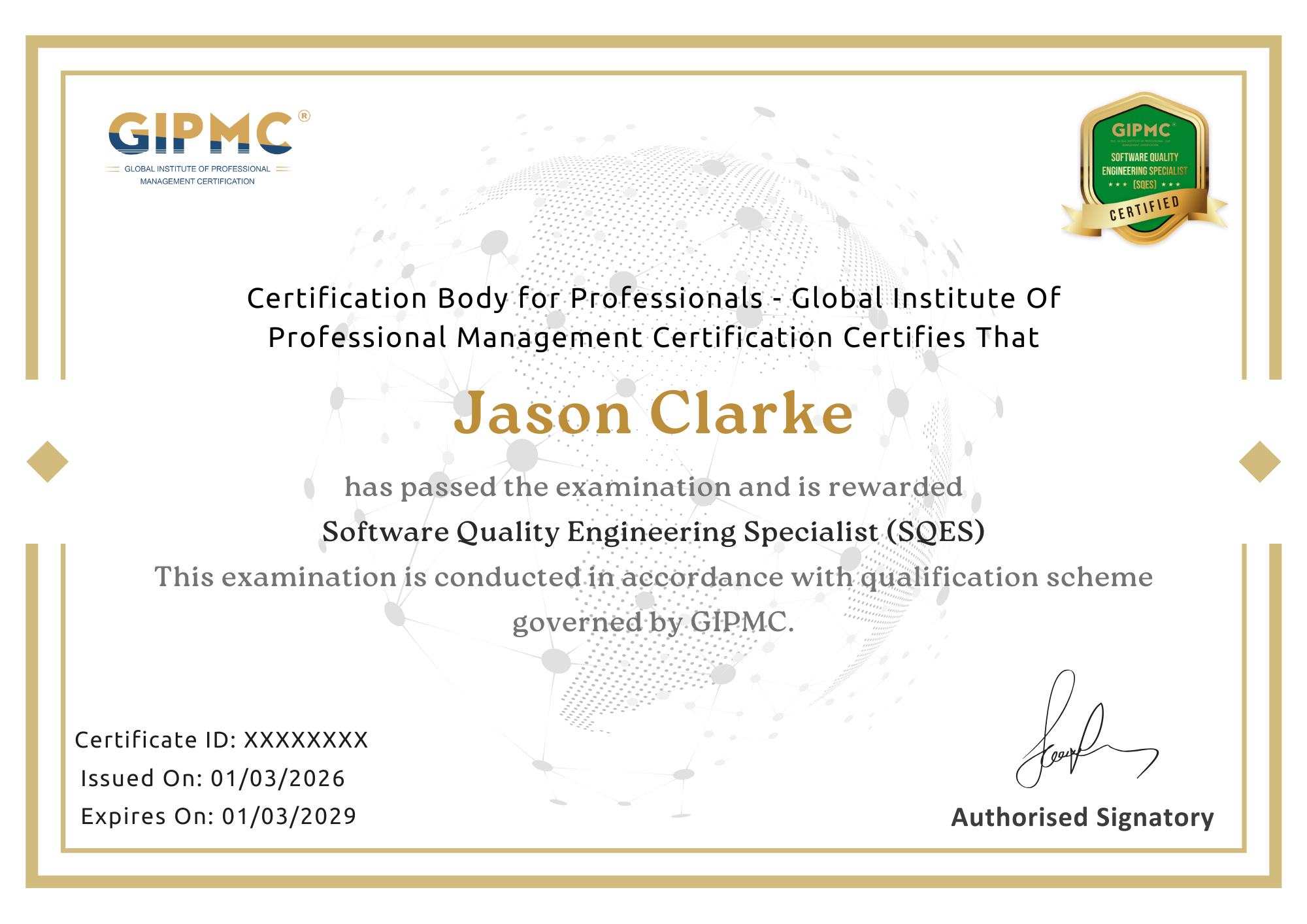
The Software Quality Engineering Specialist (SQES) certification is valid for three (3) years from the date of certification award.
Renewal Purpose
- Maintain alignment with evolving engineering practices and quality tools
- Reinforce prevention-focused and automation-driven quality approaches
- Protect the long-term professional credibility of the certification
Renewal Process Includes
- Completion of defined professional development or quality engineering knowledge refresh activities
- Successful renewal assessment or verification, as applicable
- Submission of renewal application prior to certification expiry
Timely renewal allows professionals to retain active certification status without interruption.