Course Description
Leading Product Strategy, Value Creation, and Market Impact Across the Product Lifecycle
The Product Leadership Strategist (PLS) certification is a professional credential designed to develop, validate, and recognize advanced capability in product leadership, product strategy formulation, and value-driven decision-making across the full product lifecycle.
This certification prepares professionals to lead products from vision to value realization by aligning customer needs, business strategy, technology capabilities, and market dynamics. It emphasizes product visioning, roadmap strategy, value prioritization, stakeholder leadership, governance, and performance measurement in dynamic and competitive environments.
PLS goes beyond product management execution by equipping professionals with the strategic leadership mindset and cross-functional influence required to drive susta
Why Product Leadership Strategist (PLS) from GIPMC?
As organizations increasingly compete through products and platforms, strong product leadership has become a decisive competitive advantage. PLS is industry-agnostic, framework-neutral, and leadership-focused, enabling professionals to apply product strategy principles across digital, physical, and service-based products.
Key Advantages
- Advanced product leadership and strategy credential
- Strong focus on value creation and market impact
- Framework-agnostic and methodology-neutral approach
- Emphasis on executive decision-making and governance
- Career-oriented certification with enterprise relevance
PLS is designed for professionals operating at the senior product, strategy, and leadership level.
Market Relevance
As product-centric operating models expand, organizations increasingly seek leaders who can connect strategy, execution, and customer value.
- 60–80% of product failures are linked to weak product strategy and leadership alignment
- 65–85% employer preference for senior product professionals with formal product leadership credentials
- 30–50% improvement in product value realization under structured product leadership and governance
- 2x higher market success rates for products guided by experienced product leadership strategists
(Based on aggregated global product management, innovation performance, and strategy execution trends.)
These figures demonstrate why product leadership strategy capability is critical to sustained business success.
Who Should Pursue Product Leadership Strategist (PLS)? (Target Audience)
The Product Leadership Strategist (PLS) certification is suitable for professionals responsible for product direction, strategy, and outcomes, including:
- Senior Product Managers and Product Leaders
- Heads of Product and Product Directors
- Product Owners operating at strategic level
- Innovation, Digital, and Transformation Leaders
- Business and Technology Strategy Professionals
- Entrepreneurs and Product-Focused Executives
- Consultants supporting product strategy and governance
Across industries, PLS provides a structured framework for strategic product leadership.
Detailed Learning Outcomes
By earning the Product Leadership Strategist (PLS), candidates demonstrate competencies consistent with a CAPM project management certification, including the ability to:
1. Foundations of Product Leadership
- Role of product leadership in organizational success
- Difference between product management and product leadership
- Leadership responsibilities across the product lifecycle
2. Product Vision and Strategic Intent
- Crafting compelling product vision and purpose
- Aligning product direction with organizational strategy
- Translating vision into strategic intent
3. Market, Customer, and Value Insight
- Understanding customer problems and market dynamics
- Value proposition design and validation
- Competitive and ecosystem awareness
4. Product Strategy and Roadmap Governance
- Defining product strategy and strategic themes
- Governing product roadmaps
- Managing trade-offs and priorities
5. Value-Based Prioritization and Decision-Making
- Evaluating initiatives based on value and impact
- Balancing innovation, risk, and return
- Making informed strategic product decisions
6. Product Portfolio and Investment Alignment
- Managing multiple products and initiatives
- Aligning investments with strategic outcomes
- Optimizing product portfolios
7. Cross-Functional Leadership and Influence
- Leading across engineering, design, marketing, and operations
- Influencing without direct authority
- Building alignment and accountability
8. Governance, Risk, and Product Accountability
- Establishing product governance frameworks
- Managing product risks and dependencies
- Ensuring accountability for outcomes
9. Product Delivery Models and Operating Structures
- Product operating models and team structures
- Aligning delivery models with strategy
- Supporting sustainable execution
10. Metrics, Outcomes, and Product Performance
- Defining meaningful product success metrics
- Measuring outcomes, not just outputs
- Using insights to guide strategy
11. Scaling Products and Market Expansion
- Managing growth, scale, and complexity
- Adapting strategy for new markets and segments
- Sustaining value at scale
12. Leading Change and Product Transformation
- Driving product-led transformation
- Managing organizational change
- Embedding product thinking across the enterprise
13. Professional Practice and Product Leadership Maturity
- Assessing product leadership maturity
- Continuous improvement of product strategy
- Preparing for executive product roles
Professional and Career Benefits
Product Leadership Strategist (PLS) certified professionals are recognized for their ability to:
- Lead products with strategic clarity and market focus
- Improve product success rates and value realization
- Align teams and stakeholders around product vision
- Strengthen governance and decision-making
- Drive sustainable product-led growth
The certification supports career advancement into roles such as:
- Product Leadership Strategist
- Head of Product or Product Director
- Chief Product Officer (CPO) pathway
- Product Portfolio or Strategy Lead
- Innovation and Transformation Leader
- Executive Product and Business Leadership Roles
Certification Validity & Renewal
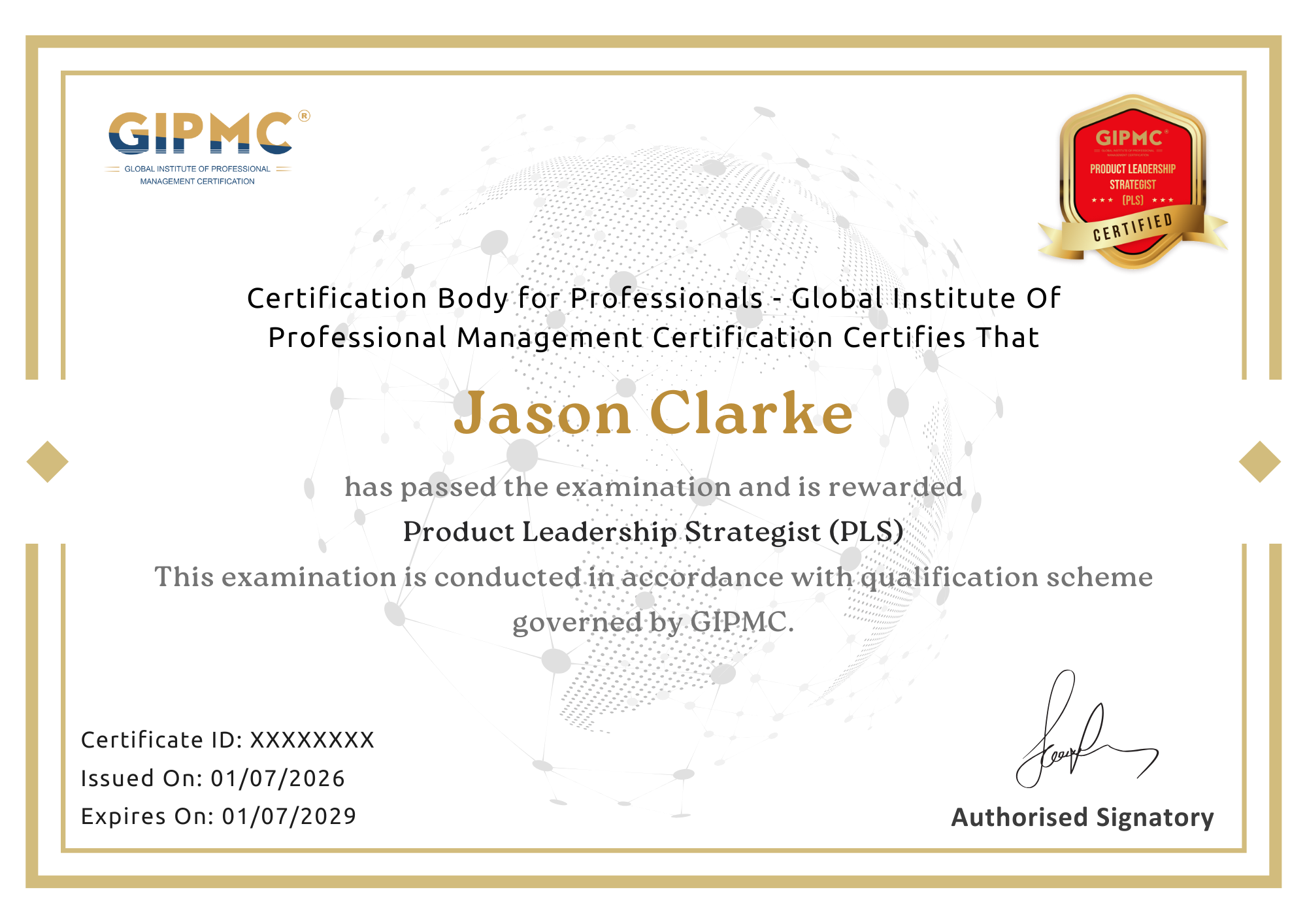
The Product Leadership Strategist (PLS) certification is valid for three (3) years from the date of certification award.
Renewal is designed to:
- Maintain professional credibility
- Ensure continued alignment with evolving product strategy and leadership practices
- Protect the long-term value of the certification
Renewal Process Includes:
- Completion of defined continuing professional development or knowledge refresh requirements
- Successful renewal assessment or verification, as applicable
- Submission of renewal application before certification expiry
Timely renewal allows professionals to retain active certification status without interruption.